Amrize and Helical Works
Collaborative Engineering for Continuous Improvement

Amrize is a major independent North American building materials company that operates over 1000 sites across the US and Canada and employs more than 19,000 people.
Unlike most of their facilities which produce building materials, their operation in Kamloops, BC, is an agriculture-oriented production site, having transitioned in 2017 from a traditional cement-focused facility.
As part of that shift, the team in Kamloops began developing a granulation process to produce gypsum-based agricultural products used across Western Canada, including applications in canola fields and commercial mushroom farming.
As Amrize made this transition at their Kamloops facility, they required new material-handling solutions that could support evolving process requirements, frequent iteration, and long-term reliability under demanding operating conditions.
The key component of this granulation system was a conditioning auger—a screw conveyor responsible for preconditioning gypsum so it could accept a binding agent prior to granulation.
The challenge wasn’t simply building a functioning screw conveyor, but rather developing a component that could:
In short, this auger needed to be both a production asset and an R&D tool.
“Honestly, that’s the most amazing and beneficial thing ever, to be able to sketch my ideas on a napkin, send them to Dave Hiebert down in Abbotsford, and wait for them to turn them into actual blueprints.”
Helical Works and Amrize worked closely together to develop—and continually refine—the conditioning auger over multiple generations.
From the outset, Helical’s engineering team worked directly with Amrize to translate operational ideas into detailed, build-ready plans.
According to Matt McCarthy, Maintenance Manager at the Amrize plant in Kamloops, this service has been outstanding since the beginning of their partnership with Helical. “Honestly, that’s the most amazing and beneficial thing ever,” he said, “to be able to sketch my ideas on a napkin, send them to Dave Hiebert down in Abbotsford, and wait for them to turn them into actual blueprints.”
That open, back-and-forth process allowed design intent to be preserved while ensuring manufacturability and structural integrity.
The same flexibility and cooperation were evident in the iterative design. Rather than treating the auger as a one-time build, both teams approached it as an evolving system. Over several years, the unit was incrementally upgraded—made larger, heavier, and stronger—as real-world performance data informed each new generation.
One of the most impactful innovations was a move toward modular flighting. By designing bolt-on sections instead of a single monolithic screw, Amrize could:
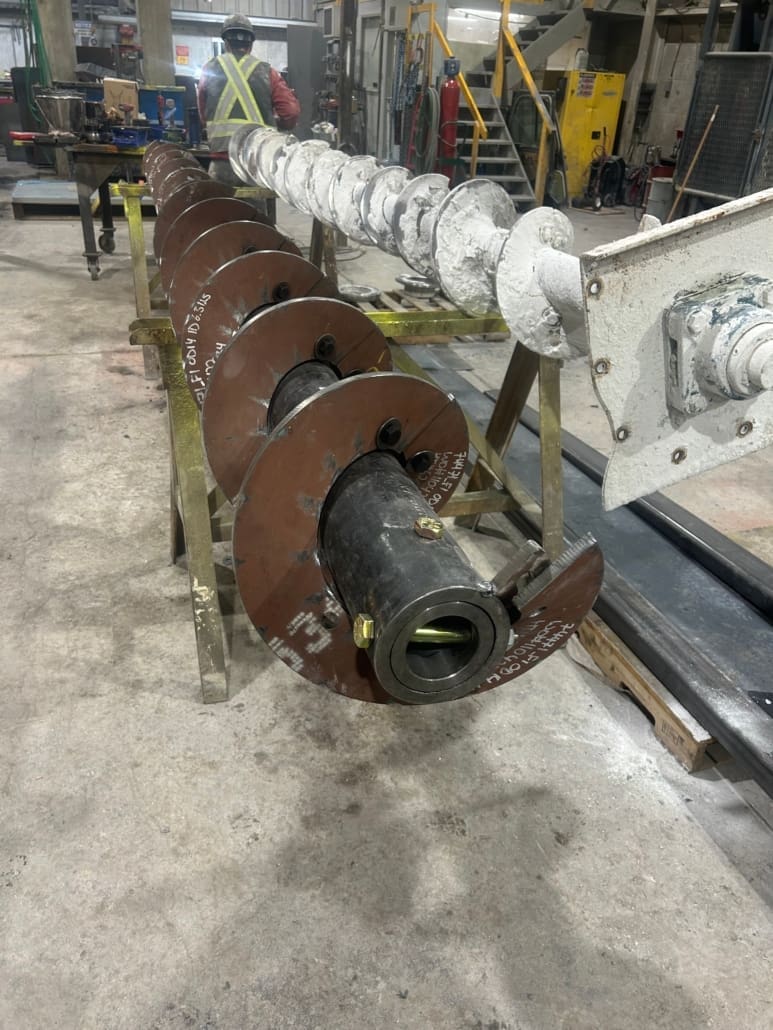
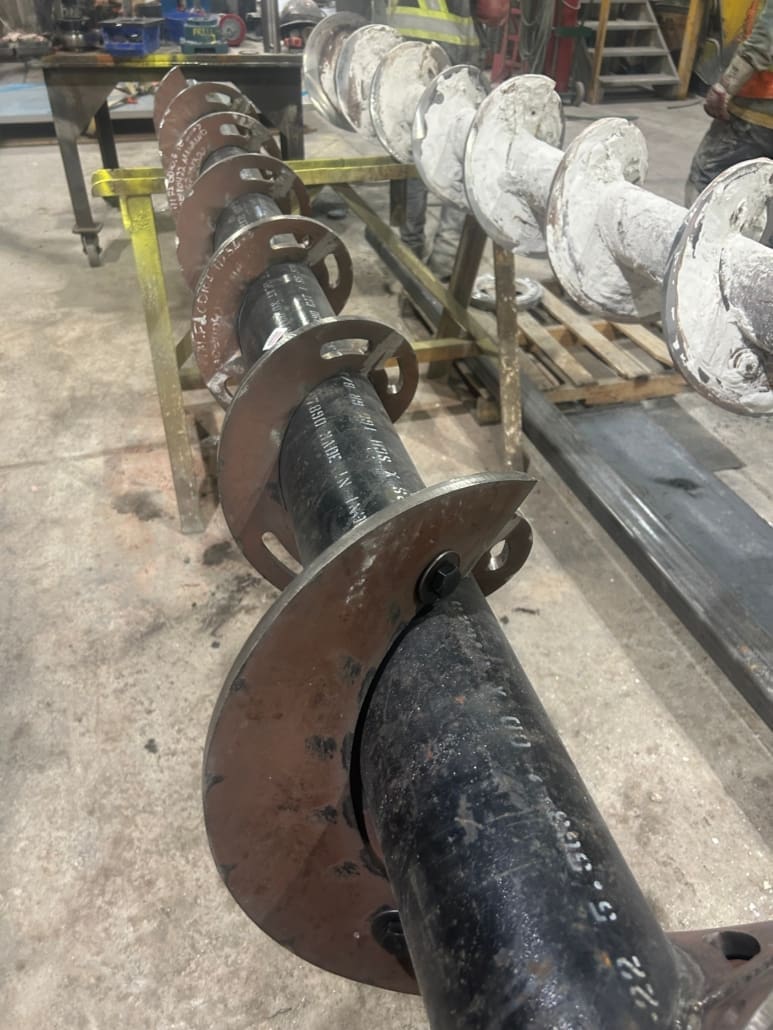
This modular approach turned the auger into what Amrize described as a form of live R&D—a working asset that continuously generated insight. “That conditioning auger has allowed us to test theories and concepts and gather critical information,” said McCarthy. “As we change it and adapt it, we built other projects on site based on what we learned from it.”
Clear communication and mutual respect were central to the partnership. Design changes, feedback from the field, and improvement ideas moved quickly from concept to execution, enabling faster learning cycles and better outcomes.
As far as the product itself, the result ws a highly customized conditioning auger that performed its production role while doubling as a proving ground for future plant improvements.
More importantly, though, the collaboration delivered something harder to quantify but critical in industrial operations: trust.
McCarthy’s own words speak clearly: “Obviously, it means a lot that I’m willing to ship things to a shop in Abbotsford to get the work done. I wouldn’t normally do that, but we have no other shop locally that we trust in the same way. It’s inconvenient, but we stick with it because it works.”
So, despite being located four hours away, Amrize continues to rely on Helical Works for this critical equipment because the partnership consistently delivers:
The conditioning auger project stands as a real-world example of how collaborative engineering and long-term thinking can create equipment that not only works—but keeps getting better.

Office & Mailing Address:
#110 – 2125 Windsor Street
Abbotsford, B.C.
V2T 6L9
Shipping Address:
#110 – 2138 Carpenter Street
Abbotsford, B.C.
V2T 6B4
Phone: 1-833-296-2234
Fax: info@helicalworksco.com